
History
Urban Indigenous Timeline in BC
Indigenous people have been moving from their territories and towns throughout BC over the past 70 years. In the past 15 years, the rate of people moving off reserve into non-reserve spaces has greatly increased.
Please note: This is an evergreen timeline and is continuously evolving as urban Indigenous people continue to organize and garner representation in BC.
If you have feedback about this timeline and/or have something to add, please reach out to us!
[email protected].
1911

The Indian Tribes of the Province of British Columbia holds its first conference in Victoria. Roughly one hundred chiefs and leaders from all parts of BC meet Premier McBride to demand acknowledgement of Indigenous rights and title. Chief Chiekleets of Douglas Lake heads the delegation, and Peter Kelly (Haida) is appointed as speaker to the group.
1912

Allied Indian Tribes of BC is formed, led by Peter Kelly and Andrew Paull (Squamish), in response to the McKenna-McBride Commission that will result in new reserve boundaries and the loss of valuable land from certain reserves, referred to as “cut-off lands”, mostly in urban areas.
1920

Allied Indian Tribes of BC travels to Ottawa to protest Duncan Campbell Scott’s Bill 14 – legislation that would make it legal to enfranchise any adult Indian without their consent, and to force First Nations children to go to school. After the protest, the law is not repealed but it is never put into practice.
1923

Allied Indian Tribes of BC petitions the federal government to assist in repealing the 1920 provincial Act implemented from the recommendations contained within the McKenna-McBride Commission. Peter Kelly, Andrew Paull, and 12 other leaders meet with Charles Stewart and Duncan Campbell Scott. Kelly writes about this visit: “the power of unity that existed among all BC Indian Tribes at that time”. In 1929, the Allied Indian Tribes of BC dissolved after government made it illegal to pursue land claims. Ga’axasta’las (Jane Constance Cook, featured in photo) was the only woman to serve on the executive of the Allied Indian Tribes of BC.
1931

The Native Brotherhood of British Columbia is born, beginning on the fishing grounds of the North Coast. Andrew Paull and Peter Kelly continue to serve as leaders. The Native Brotherhood successfully meets goals to improve lives of First Nations people, tirelessly battling for better education, housing, and health care services. The Native Brotherhood gives way to local chapters including Native Sisterhoods throughout communities across the province.
1959

North American Indian Brotherhood forms by George Manuel, building on earlier activities of Andrew Paull. The North American Indian Brotherhood eventually evolves into the Assembly of First Nations.
1950-1970s

Various Tribal and District Councils form including: Southern Vancouver Island Tribal Federation; West Coast Allied Tribes of the Nuu-chah-nulth; Nishga Tribal Council led by Frank Calder; Gitksan-Carrier; Kwakiutl District Council; Terrace District Councils.
1950-1970s

Emergence of Friendship Centres across BC including Chetwynd, Dawson Creek, Duncan, Fort Nelson, Fort St. John, Kamloops, Kelowna, Lillooet, Merritt, Mission, Nanaimo, Port Alberni, Prince George, Prince Rupert, Quesnel, Smithers, Terrace, Vancouver, Vernon, Victoria, and Williams Lake.
1969, March

H.A. Butch Smitheram, a non-status Indigenous man from Penticton, forms the British Columbia Association of Non-Status Indians (BCANSI). Butch believes that nonstatus Indians and Métis are entitled to same benefits as status Indians. BCANSI membership is open to any person of “one-quarter or more Indian blood” who is not a status Indian. 70+ local chapters emerge throughout province.
1969, May
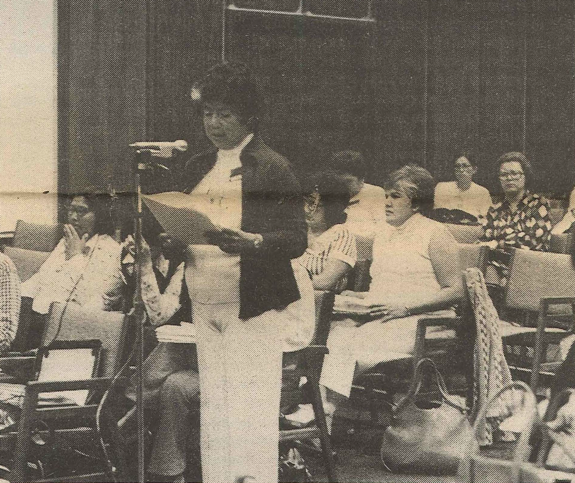
Indian Homemakers’ Association is founded by Dr. Rose Charlie of Chehalis.
1969, November

The Union of BC Indian Chiefs is formed in response to the federal government’s “white paper” aiming to assimilate First Nations people. UBCIC’s main goal is to attain a comprehensive land claims settlement for First Nations in BC. In 1977 George Manuel becomes president.
1972

Native Courtworker Association of BC is formed.
c. 1974

BC Native Woman’s Society forms.
1975

BCANSI changes name to United Native Nations (UNN) and alters its membership criteria, extending membership to “status Indians” and anyone with “onequarter or more Indian blood”. The UNN dissolved in 2013.
1976

Alliance of BC Indian Bands forms, composed
initially of Musqueam, Squamish and Westbank (Okanagan) Bands. Joe Mathias (Squamish) and Delbert Guerin (Musqueam) are speakers. Dissolved in 1982.
1977

Joe Mathias (Alliance), Ed Newman (Brotherhood), and Bill Wilson (UNN) form the BC Coalition of Native Indians as a “coordinating forum” (as opposed to forming a new organization). The Coalition aims to coordinate provincial efforts of each member organization regarding land claims action and other issues for Indigenous people.
1978

Aboriginal Council of British Columbia forms to replace the Coalition of Native Indians. The Council consists of two delegates, one status and one non-status, from each tribal group and is designed to coordinate land claims activity by the individual tribal groups.
1980

Wayne Christian, chief of Spallumcheen Band, launches an initiative to challenge the removal of Indigenous children to non-Indigenous homes and leads the “Indian Child Caravan” and march to Vancouver home of Minister of Human Resources. UBCIC begins to vigorously lobby Ottawa regarding the removal of Indigenous rights and title in the constitution. George Manuel and others lead the Constitution Express to Ottawa and Europe.
1982

BC Association of Aboriginal Friendship Centres is founded to support the growing number of Friendship Centres that are emerging throughout BC.
1990

The First Nations Summit forms with an original mandate to advance discussions with the governments of Canada and BC to support First Nations in conducting their own direct treaty negotiations with Canada and BC.
1992-1999

A range of provincial based organizations emerge to support various efforts in education, child welfare, housing and more:
– First Nations Education Steering Committee
– Caring for First Nations Children Society, (now operating as the Indigenous Perspectives Society)
– Aboriginal Financial Officers Association of BC
– Aboriginal Housing Management Association
– BC Aboriginal Child Care Society
– Federation of Aboriginal Foster Parents
– Aboriginal Head Start Association of BC
1996

Métis Provincial Council of BC was born, later to become the Métis Nation BC (MNBC).
2000-2009

More provincial organizations emerge by and for the Indigenous community:
– BC Elders Communication Center Society
– Aboriginal Infant Development Program
– First Nations Health Council
– Indigenous Sport, Physical Activity and Recreation Council (I-SPARC)
2005

First Nations Leadership Council formed through working relationship between BC Assembly of First Nations, First Nations Summit, and Union of BC Indian Chiefs. Council enters into New Relationship with the Province of BC to “restore, revitalize and strengthen First Nations and their communities and families to eliminate the gap in standards of living with other British Columbians, and substantially improve the circumstances of First Nations people in areas which include: education, children and families, and health…”
2006

MNBC signs Métis Nation Relationship Accord to strengthen relationship with Métis people and close the gap in quality of life for Métis people in BC.
2007

First Nations Health Council establishes to support BC First Nations in implementing the Tripartite First Nations Health Plan.
2010

First Nations Health Directors Association forms to advance health planning and service delivery on behalf of First Nations in BC. First Nations Health Authority establishes
2009-2021

Various urban coalitions emerge in BC representing leadership from range of urban Indigenous organizations in social, cultural, economic, health, housing, human resources and education: Metro Vancouver Aboriginal Executive Council (MVAEC), Prince George’s Urban Aboriginal Working Group (UAWG); Victoria Urban Reconciliation Dialogue (VURD); Surry Urban Indigenous Leadership Committee (SUILC).
2011

BC Friendship Centres’ successful lobby results in Off Reserve Aboriginal Action Plan (ORAAP) announcement in BC’s Speech from the Throne, acknowledging importance of the off-reserve and urban Indigenous populations in BC.
2015

Northwest Indigenous Council forms as a provincial advocacy organization to act on behalf of BC’s urban and off-reserve Indigenous population and aims to be the political voice for BC’s urban Indigenous community.
2019

BC passes the Declaration on the Rights of Indigenous Peoples Act, resulting in five-year Action Plan designed to meet objectives of the UN Declaration on the Rights of Indigenous Peoples.
2022

Efforts by various groups such as urban coalitions successfully lead to in the inclusion of actions specific to addressing the needs of urban Indigenous people and communities within the BC the Declaration Act Action Plan.
Want to get involved?
Get In Touch
British Columbia is comprised of the traditional territories of many distinct First Nations. We are grateful to all the First Nations who have cared for and nurtured the lands and waters around us since time immemorial. We honour their right to be included in all matters related to their territories. We further recognize the Métis, Inuit, and urban Indigenous Peoples living in the territories who make valuable contributions to our collective wellness.